Choosing wrong isn't a small mistake. Overpay for guarantees you don't need, or take on market risk you can't stomach, and you'll end up under-insured or scrambling to restructure a policy years later. In 2025, whole life premiums hit $6.4 billion (up 7%), while IUL premiums set a record at $4.5 billion (up 17%) — proof that both products have real, growing demand behind them (LIMRA, 2026).
This guide breaks down definitions, cost and growth differences, and how to decide based on your risk tolerance and financial goals.
Quick Summary
- Whole life delivers fixed premiums, guaranteed cash value, and a locked-in death benefit
- IUL trades some guarantees for flexible premiums and market-linked growth with caps and floors
- Both build cash value tax-deferred; IUL needs more active monitoring
- Choose based on budget, risk comfort, and goals—legacy protection vs. tax-advantaged growth
Whole Life vs IUL: Quick Comparison
| Factor | Whole Life | IUL |
|---|---|---|
| Premiums | Fixed for life | Flexible, within carrier limits |
| Cash Value Growth | Guaranteed fixed rate, sometimes with dividends | Tied to a market index, with a floor and cap |
| Death Benefit | Fixed and guaranteed | Adjustable, can rise or fall |
| Complexity | Low maintenance | Requires monitoring caps, floors, and fees |
| Best Fit | Conservative buyers wanting predictability | Buyers comfortable with moderate risk seeking growth |
Whole life is the "set it and forget it" option. IUL asks you to stay engaged—watching caps, fees, and funding so the policy performs as intended.

What Is Whole Life Insurance?
Whole life is permanent coverage: fixed premiums, a guaranteed death benefit, and cash value that grows at a guaranteed rate for the life of the policy. Some carriers, like MassMutual and Northwestern Mutual, are "participating" insurers that may also pay dividends. Dividends are never guaranteed and are not the same as the policy's guaranteed rate of return (MassMutual).
Why buyers like it:
- Predictable premiums make budgeting simple
- Cash value builds at a guaranteed rate, typically 1%–3% annually
- Participating policies may add dividend payouts on top
For context, Northwestern Mutual's 2026 dividend interest rate is 5.75% for most policies. That figure is a dividend rate, not guaranteed cash-value growth, and it can change year to year (Northwestern Mutual).
Cost varies by age. A 2025 Policygenius sample for a $100,000 policy on a healthy nonsmoker showed $75/month at age 30, climbing to $290/month at age 60 (Policygenius, 2025).
Underwriting also shapes who can buy. Some whole life products, called guaranteed issue, skip the medical exam entirely — a common path for older buyers or people with health complications.

Use Cases of Whole Life
Whole life fits two main needs: final expense coverage and legacy planning.
- Final expense: Seniors buy small policies (often $2,000–$40,000) for funeral and burial costs with lighter underwriting
- Legacy planning: Families lock in a guaranteed death benefit for heirs, regardless of market conditions
Middle America Financial offers final expense whole life with simplified or guaranteed-issue underwriting, so older buyers and people with health issues can often qualify without a full medical exam. Coverage may pay from day one or after a short graded period, depending on the product.
What Is IUL (Indexed Universal Life)?
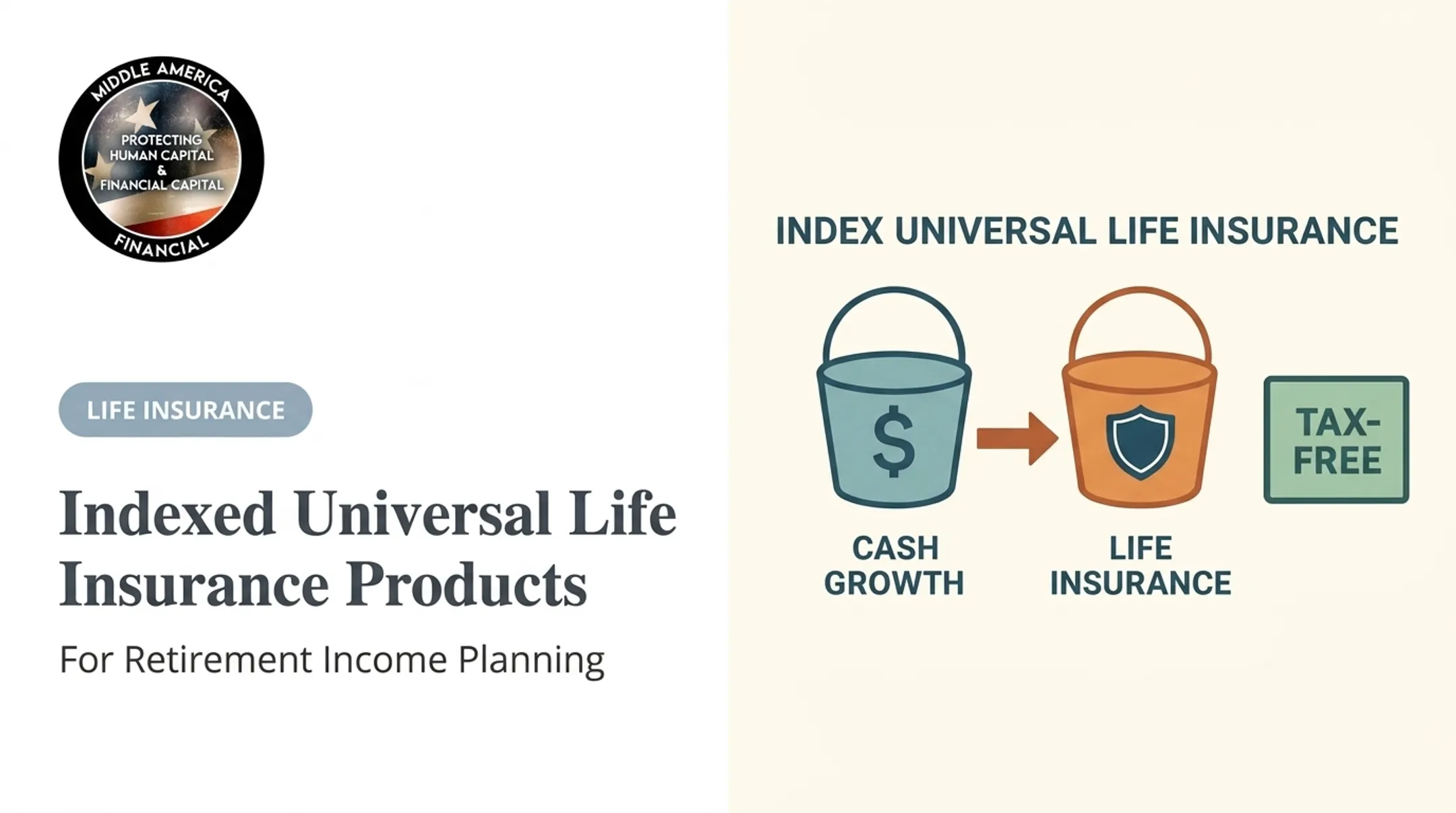
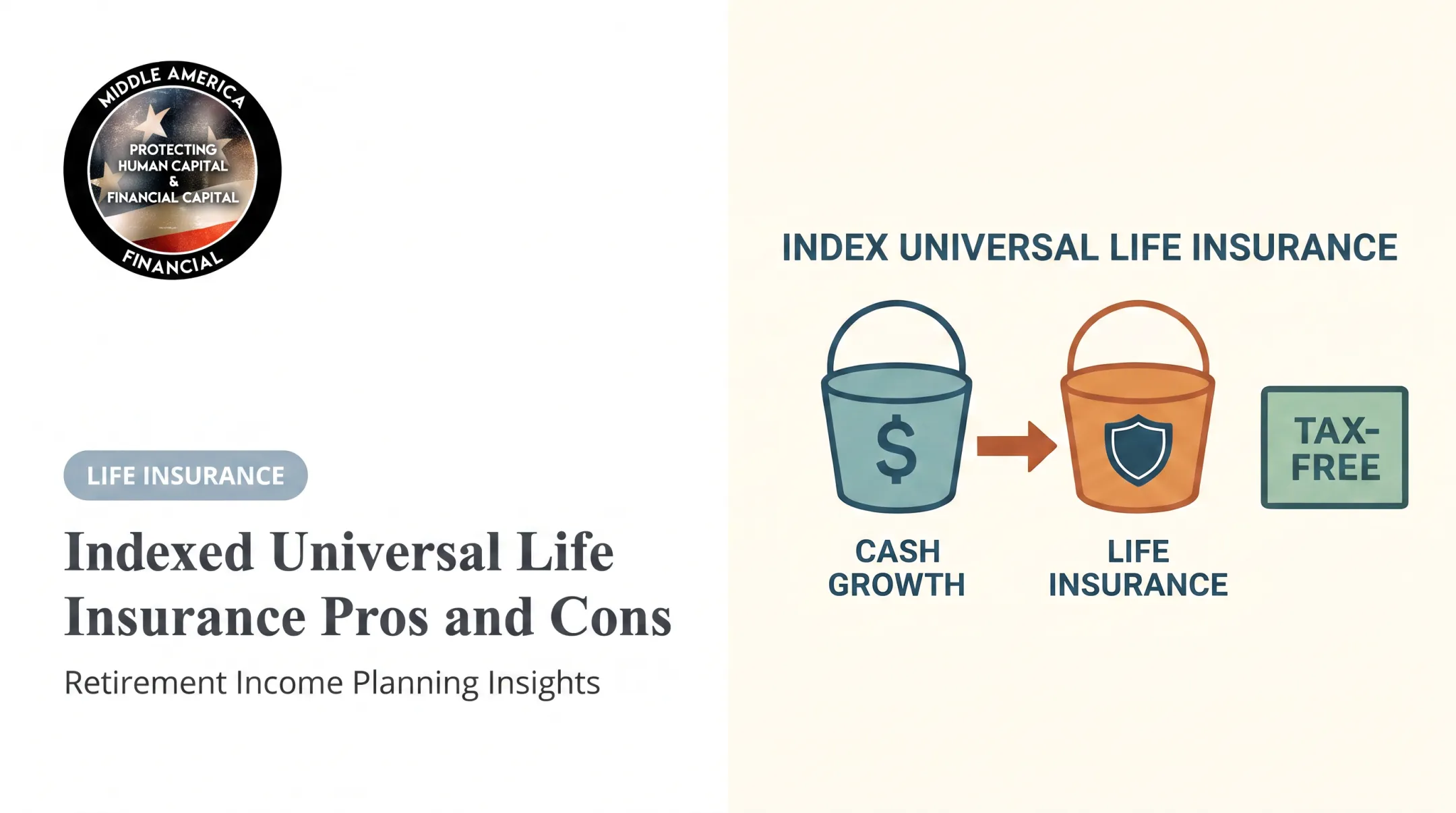
IUL is a type of universal life insurance where your cash value growth is tied to a market index, like the S&P 500, rather than a fixed guaranteed rate. Your money isn't actually invested in the market. The insurer credits interest based on index performance, subject to a floor (often 0%, protecting you from losses) and a cap (limiting your upside).
For example, Principal's rate sheet lists a 9.00% cap and 0% floor on an S&P 500 index account, with 100% participation (you get the full credited rate up to the cap, but nothing below zero) (Principal, 2026).
Core benefits:
- Flexible premiums within carrier limits
- Growth potential that can exceed fixed-rate whole life policies
- Downside protection: a 0% floor means index drops don't directly reduce credited interest
One important caveat: a 0% floor doesn't mean your cash value can never shrink. Policy charges, loans, and withdrawals can still erode it, even in a flat or positive index year (Pacific Life).

IUL differs from variable universal life (VUL), which directly invests cash value in market subaccounts and carries real investment risk. IUL's crediting method avoids that direct exposure.
Use Cases of IUL
Higher earners and business owners often use IUL for tax-advantaged growth beyond a 401(k) or IRA.
- Access cash value for supplemental retirement income through withdrawals or loans (loans generally aren't taxable, though interest accrues and unpaid loans can create taxable gain if the policy lapses)
- Support business planning needs such as key-employee retention, succession funding, or ownership-change protection (as carriers like Allianz describe)
- Build flexible cash value alongside a permanent death benefit when premium funding stays within policy limits
If a policy is overfunded and classified as a Modified Endowment Contract (MEC) under IRC Section 7702A, loans and withdrawals lose favorable tax treatment and can trigger a 10% penalty (26 U.S.C. § 72). That risk is why IUL needs careful structuring around funding limits and long-term goals.
Middle America Financial agents help clients compare IUL options across carriers and structure policies to fit retirement income and permanent coverage needs.
Whole Life vs IUL: Which Is Better?
Neither policy wins outright. The right pick depends on four factors:
- Budget: Can you commit to a fixed premium, or do you need flexibility?
- Risk tolerance: Are guarantees non-negotiable, or can you handle capped, variable growth?
- Guarantees vs. growth: Is your priority certainty or upside potential?
- Management style: Do you want a policy you never think about, or one you'll actively monitor?

Choose whole life if you prioritize guaranteed stability, simplicity, and burial or legacy planning. It's the better fit for anyone who wants zero surprises.
Choose IUL if you're comfortable with moderate risk and want higher growth potential for retirement income or tax-advantaged accumulation.
That IUL path fits someone like a business owner in his mid-50s with a paid-off mortgage, maxed-out 401(k), and a growing tax bill. Whole life offers guarantees he doesn't need. His estate goals are already covered by other assets.
An IUL, funded strategically and monitored for cap and fee changes, gives him tax-deferred growth now and tax-advantaged policy loans later. That income can supplement what his traditional accounts already provide in retirement.
Not sure which path fits your situation? Speak with an independent agent at Middle America Financial. Agents can compare policies across 40+ carriers to match the right permanent policy to your goals, whether you want guaranteed simplicity or growth-oriented flexibility.
Conclusion
Neither policy is universally "better." Whole life suits people who value guarantees, simplicity, and a straightforward path to legacy or final expense protection. IUL suits those who want flexibility and are comfortable trading some certainty for growth potential tied to market performance.
The decision connects to real outcomes: protecting the people you love, building tax-advantaged savings for retirement, or covering final expenses so your family isn't left with the bill. Talk with a licensed independent agent at Middle America Financial for a recommendation based on your numbers, not generic assumptions.
Frequently Asked Questions
How much is a $100,000 whole life insurance policy per month?
Cost depends on your age, health, and insurer. As an illustrative U.S. range, a $100,000 fully underwritten whole life policy may run about $75/month near age 30 and $290/month near age 60 for a healthy nonsmoker; guaranteed-issue coverage usually costs more.
Which is better, whole life insurance or indexed universal life (IUL)?
Neither is universally better. Choose whole life for guarantees and predictable premiums; choose IUL if you want flexible premiums and index-linked cash-value growth and can actively manage the policy.
Which is better for me: IUL or term life insurance?
Term life is cheaper and ideal for pure income replacement during a set period. IUL costs more but adds lifelong coverage plus cash value for those wanting more than temporary protection.
Can I cash out my indexed universal life (IUL) policy?
Yes, through withdrawals or policy loans against your cash value. Doing so can reduce your death benefit and may trigger tax consequences if the policy isn't managed carefully.
Does an indexed universal life (IUL) policy have a death benefit?
Yes. IUL includes an adjustable death benefit that can rise or fall based on your cash value and how the policy is structured.
Why do wealthy people use indexed universal life (IUL) insurance?
High-income individuals often use IUL for tax-advantaged growth, potential tax-free policy loans, and supplemental retirement income that goes beyond what traditional 401(k)s and IRAs allow.