Nearly 40% of Americans don't have adequate life insurance coverage, and 46% say they simply don't know how much or what type to buy, according to LIMRA's 2025 Insurance Barometer. With mortgages, rising costs, and dependents to protect, getting this decision right matters more than ever.
This article breaks down all three policy types, compares them side by side, and gives you a practical framework for choosing the right fit for your household.
Quick Summary
- Term life: affordable, temporary protection for income replacement and mortgage payoff
- Whole life: lifelong coverage with guaranteed cash value, ideal for legacy planning
- Universal life: flexible premiums and death benefits, cash value tied to interest rates or market indexes
- Match the policy to the job: short-term income/mortgage needs favor term; lifelong legacy and cash value favor whole or universal
- Compare before you buy: an independent agent can line up quotes and features across multiple carriers for your budget and goals
What Is Family Life Insurance?
Family life insurance is coverage designed to protect the people who depend on your income or caregiving. Families usually meet that need with a combination of policies rather than a single product.
Most households build coverage in layers. A typical mix might include:
- A large term policy on the primary breadwinner
- A smaller whole life policy for final expenses
- A rider covering a child
Each piece serves a different role based on who earns income, provides care, or carries financial responsibility. Together, those policies cover income replacement, final expenses, and dependent protection as part of a broader financial plan.

Why Choosing the Right Type Matters for Families
Mismatched coverage creates two problems: being underinsured or overpaying for protection you don't need.
Common consequences of poor planning include:
- Policies that lapse because premiums became unaffordable
- Payouts too small to cover a mortgage or replace years of lost income
- Missed opportunities for cash-value growth when permanent coverage would've fit better
In 2024, the individual life insurance lapse and surrender rate hit 5.8%, according to the ACLI's 2025 Life Insurers Fact Book. Many of those lapses likely trace back to buying the wrong policy type for the budget.
Budget fit is only half the decision. Marriage, a new baby, a home purchase, or approaching retirement all change how much coverage you need and for how long. Knowing the three policy types before you buy makes it easier to adjust coverage when those milestones arrive.
Types of Family Life Insurance
Term, whole, and universal life serve different financial goals and time horizons. Many families end up using more than one type across different household members.
Term Life Insurance
Term life provides coverage for a fixed period, typically 10, 20, or 30 years, with a level premium and death benefit. It builds no cash value.
Why it's the cheapest option: Term is pure protection. Without a savings or investment component, insurers can price it far lower than permanent coverage.
Best suited for:
- Income replacement while kids are still dependent
- Mortgage protection until the loan is paid off
- Covering the years until children finish college
Middle America Financial sees these needs most often. Homeowners want a death benefit sized to pay off the mortgage, and working families need affordable coverage that protects the paycheck their loved ones depend on.
Limitations: Coverage ends after the term unless you convert to a permanent policy. Renewal premiums rise steeply based on your age at renewal, and there's no cash value to fall back on later.
Whole Life Insurance
Whole life is permanent coverage that lasts your entire lifetime, with fixed premiums and guaranteed cash value growth, generally in the 1%–3% range on a guaranteed basis.
How it differs from term: Everything is fixed. Premium, cash value growth, and death benefit are all locked in from day one. Some mutual insurers also pay dividends, though these are never guaranteed.
Best suited for:
- Final expense and burial coverage
- Legacy planning for heirs
- Families wanting predictable, lifelong protection without adjusting anything later
Key strengths: Coverage never expires as long as premiums are paid. Cash value grows tax-deferred and can be borrowed against later in life.
Limitations: Premiums run significantly higher than term for the same death benefit. There's also less room to adjust payments if your finances tighten.
Universal Life Insurance (Including Indexed Universal Life)
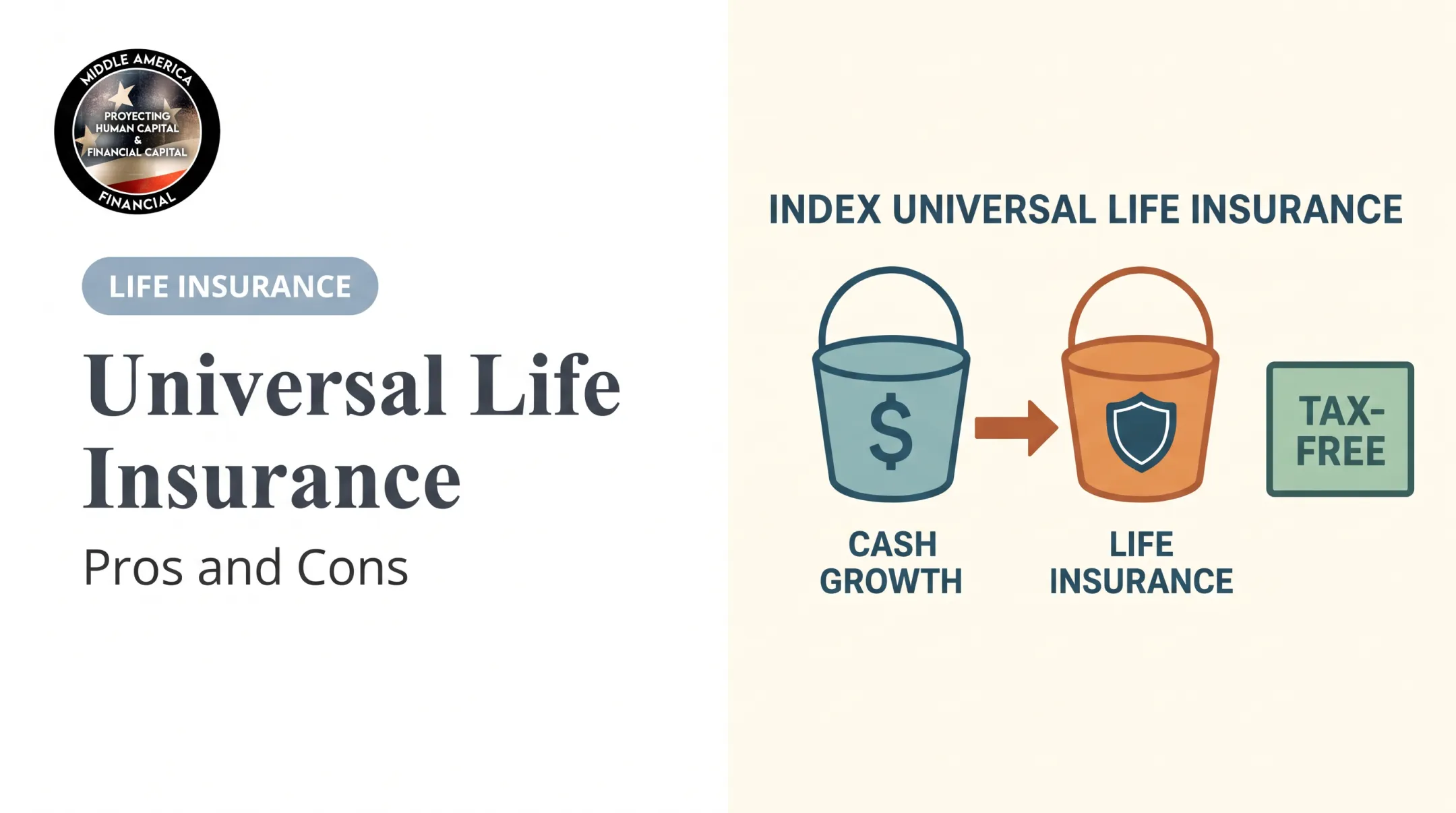
Universal life is permanent coverage with flexible premiums and death benefits. Cash value grows based on a fixed rate, a market index, or investment subaccounts.
Flexible premiums and coverage: Unlike whole life's rigid structure, universal life lets you adjust premium payments and coverage amounts as your circumstances change.
Best suited for:
- Families wanting tax-advantaged cash accumulation
- Legacy or trust-funding goals
- Business owners exploring long-term wealth strategies
Indexed universal life (IUL) ties cash value growth to an index like the S&P 500, with a guaranteed minimum floor (often 0%) and a cap limiting your upside.
Limitations: Cash value growth isn't guaranteed on indexed or variable versions. Fees, including cost-of-insurance and administrative charges, can run high. Mismanaged premiums can cause the policy to lapse entirely.

A quick cost comparison for healthy applicants, based on Policygenius rate data:
| Policy Type | Age 30 | Age 40 |
|---|---|---|
| Term ($500K, 20-yr) | ~$23-29/mo | ~$35-43/mo |
| Whole life ($500K) | ~$408-472/mo | ~$588-706/mo |
| Universal life ($250K) | ~$90-102/mo | Varies by carrier |

Term stays dramatically cheaper. That gap is exactly why so many families use term for the bulk of their coverage and layer in a smaller permanent policy for specific goals.
How to Choose the Right Policy for Your Family
The "right" type depends on your financial goals and life stage, not popularity or a single agent's recommendation.
Factors to Consider
- Purpose: Replacing income, building a legacy, or growing tax-advantaged cash?
- Time horizon: Years left on the mortgage, or until the kids finish college?
- Budget: Term is cheapest upfront; whole and universal require higher sustained premiums.
- Health and age: Carriers underwrite differently; some final expense policies use simplified or guaranteed-issue underwriting, others need full exams.
- Flexibility needs: Universal life lets you adjust premiums; whole life locks in fixed terms for predictability.
Underwriting path matters here too. 47% of consumers find accelerated or simplified underwriting more appealing than the traditional process, per Munich Re research. These faster options usually target younger, healthier applicants and may come with lower coverage limits.
Because underwriting rules and pricing vary so much by carrier, compare options across multiple companies. Working with an independent agent, such as those at Middle America Financial, gives you access to 40+ carriers instead of a single company's lineup, so the policy fits your situation.
Mistakes to Avoid When Buying Family Life Insurance
Families often make these avoidable errors when shopping for coverage:
- Buying permanent coverage for cash value when term meets the need, and overpaying for a savings component you don't need
- Underestimating coverage by counting only current expenses instead of debts, future education costs, and years of lost income
- Skipping low-cost riders such as a child term rider or waiver of premium that add real protection for little extra cost
- Failing to revisit coverage after major life events like a new baby, a home purchase, or an income change
Conclusion
Term, whole, and universal life each serve different financial goals. The right mix depends on your household's income needs, budget, and how long you want coverage to last.
Understanding these differences helps you avoid two costly outcomes: being underinsured when your family needs coverage most, or overpaying for features you'll never use.
Request a free consultation with a Middle America Financial agent to match term, whole, or universal coverage to your family's protection goals.
Frequently Asked Questions
What does family life insurance mean?
It refers to a combination of policies covering household members to protect against financial loss from death, not one single "family policy." Most households mix policy types based on each person's role.
Is there any insurance for the whole family?
Some riders cover multiple family members, like child riders, but most families need individual policies tailored to each person's role and needs.
Which is better, term life or universal life insurance?
Neither is universally better—match the product to your goals. Term offers affordable temporary protection; universal life offers flexible lifelong coverage and cash value growth at a higher cost.
At what age is life insurance not worth it?
Your obligations matter more than your age. If debts are paid off and dependents are financially independent, your need drops—though final expense coverage may still make sense.
What happens after 10 years of paying life insurance?
For term policies, coverage continues until the level-term period ends. At that point, renewal rates rise sharply, or you can convert to permanent coverage instead.
Can I get life insurance for my 75-year-old mom?
Often, yes, through guaranteed-issue whole life or final expense policies. Coverage amounts and options narrow with age, but products exist for issue ages up to 80 or 85.