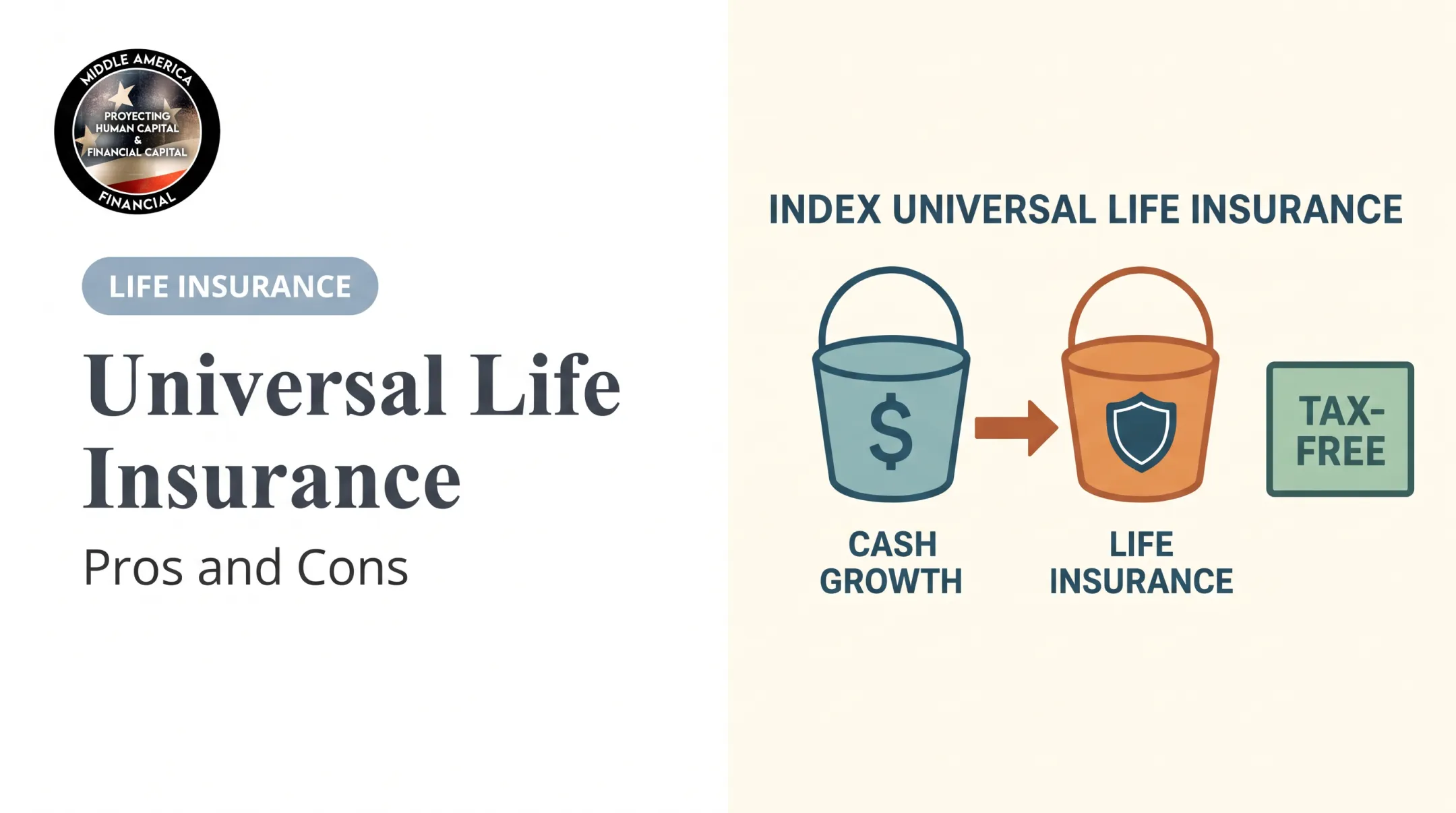
But universal life isn't automatically a smart move for every household. It depends on your goals, your budget, and how closely you're willing to monitor the policy over the years.
This article breaks down how universal life works, where it shines, where it can disappoint, and how it stacks up against term and whole life insurance. We'll also cover realistic cost ranges and what to check before you buy or replace a policy.
Quick Summary
- Universal life gives permanent coverage and cash-value growth only with steady funding and regular policy reviews.
- Flexible premiums aren’t optional: underfunding can drain cash value, raise costs, or lapse the policy.
- Use term life for affordable income or mortgage protection; use universal life for permanent coverage or wealth transfer.
How Universal Life Insurance Works
Universal life (UL) is a form of permanent life insurance built to stay in force for your entire life, as long as the policy is properly funded. That's the core difference from term insurance, which only covers a set window, typically 10, 20, or 30 years, and pays nothing if you outlive the term.
Each premium payment you make gets split three ways:
- Cost of insurance — the mortality charge that pays for the death benefit itself
- Administrative or policy charges — fees the insurer deducts for maintaining the contract
- Cash value account — whatever's left after charges, credited with interest
For illustration purposes only: if you pay $200 a month and $150 goes toward insurance and fees, roughly $50 lands in the cash value account. That's a simplified example, not a guaranteed outcome. Actual splits shift as you age and as insurance costs rise.

Flexible Premiums Have Limits
UL policies let you adjust how much and how often you pay, within contract limits. Pay less than the planned premium, and cash value may have to cover the shortfall in insurance charges. That shortfall can:
- Shrink future cash value growth
- Force higher payments later to keep coverage on track
- Push the policy toward lapse if the account runs dry
Death Benefit Options
Most UL policies offer two structures:
- Level death benefit: Payout stays fixed; cash value growth effectively lowers the insurer's net amount at risk over time
- Increasing death benefit: Payout equals the face amount plus cash value, usually costs more, and may need added underwriting to raise coverage
Three Main Types of Universal Life
| Type | Guarantees | Cash Value Treatment | Investment Exposure |
|---|---|---|---|
| Guaranteed UL (GUL) | Fixed death benefit if funded as planned | Minimal cash value | None |
| Indexed UL (IUL) | Floor and cap on interest credits | Tied to an index like the S&P 500 | Indirect, no direct market investment |
| Variable UL (VUL) | Few guarantees | Invested in market subaccounts | Direct, can lose principal |
Carriers also sell simplified-issue IUL options. Coverage may be structured to a minimum age such as 80 and, on some contracts, up to 120, with issue ages often running from 18 to 70. Exact guarantees, caps, and issue limits depend on the carrier and the contract—always read the policy illustration and form.
Policy Loans and Withdrawals
You can access cash value through loans or withdrawals while the policy is in force. Treat that access carefully:
- Outstanding loans reduce the death benefit dollar for dollar
- Heavy borrowing can weaken long-term policy performance
- A lapse with an unpaid loan balance can trigger taxable income
Universal Life Insurance Pros and Cons
The Case For Universal Life
- Lifetime coverage — Unlike term, UL can stay in force for life if you fund it properly. That fits needs that outlast your working years: estate liquidity, final expenses, business succession, or a legacy.
- Flexible premiums and benefits — You can often adjust premiums and death benefits as income or coverage needs change, subject to policy terms. Business owners with uneven cash flow may pay more in strong years and less in lean ones.
- Tax-deferred cash value — Cash value generally grows without annual income tax inside the policy. Death proceeds are usually income-tax-free to beneficiaries.
- Tax caveats still apply — IRS Publication 525 notes that interest paid with proceeds can be taxable, and surrenders above your cost basis are included in income. Treatment depends on how the policy is structured and used.
The Case Against Universal Life
- Layered costs — Expect mortality charges, administrative fees, and sometimes surrender charges or subaccount expenses (IUL/VUL). Costs change over time—review a current illustration or carrier disclosure, not rough estimates.
- Performance can fall short — Several factors can weaken results:
- Non-guaranteed cash value projections that never materialize
- Rising cost-of-insurance charges as you age
- Weak returns in indexed or variable subaccounts
- Underfunding that drains cash value to keep the policy alive
- Outstanding loans that cut the death benefit or trigger a lapse
- Ongoing oversight required — UL is not set-and-forget. Recheck funding, cash value, charges, and beneficiaries with a licensed professional on a regular schedule.

What Does Universal Life Insurance Cost?
Universal life premiums vary based on age, health, tobacco use, coverage amount, policy type, death-benefit option, riders, and how aggressively you fund the policy. There's no single "average" cost that applies to everyone.
Here are sample guaranteed universal life monthly premiums for Standard non-smokers, based on a Policygenius illustration valid as of early 2024:
| Issue Age | Female: $100K / $250K / $500K | Male: $100K / $250K / $500K |
|---|---|---|
| 30 | $63 / $110 / $194 | $68 / $123 / $219 |
| 40 | $84 / $164 / $298 | $93 / $182 / $338 |
| 50 | $118 / $247 / $468 | $132 / $275 / $525 |
| 60 | $184 / $400 / $770 | $204 / $448 / $866 |
Source: Policygenius guaranteed universal life illustration. These are estimates, not quotes. Your actual premium will depend on underwriting.
How to Read a Quote or Illustration
When you get an illustration, look past the headline premium:
- Compare guaranteed vs. non-guaranteed columns: guaranteed figures are what you can count on
- Check minimum vs. planned premiums: the minimum may keep the policy alive today, not for decades
- Review cost-of-insurance assumptions: these charges typically rise with age
- Note surrender charge timelines: canceling early can wipe out cash value
- Check the projected lapse date under both guaranteed and current assumptions
A low starting payment can be misleading. If cash value grows slower than illustrated or insurance charges rise faster than projected, you may have to pay more later just to keep the policy in force.
Universal Life vs. Term Life vs. Whole Life
| Factor | Term Life | Whole Life | Universal Life |
|---|---|---|---|
| Duration | 10–30 years | Lifetime | Lifetime, if funded |
| Premiums | Fixed for the term | Fixed, predictable | Flexible within limits |
| Cash value | None | Yes, guaranteed growth | Yes, growth often not guaranteed |
| Relative cost | Lowest | Higher | Between term and whole life |
| Management needed | Minimal | Low | Ongoing |
Term life works well for working families focused on income replacement, mortgage protection, or covering dependent-care years. It's a straightforward death benefit without cash value complexity, and when the term ends, you can typically renew, convert, or let it expire.
Whole life appeals to people who want permanent coverage with predictable premiums. Cash value grows at a guaranteed fixed rate, often in the 1% to 3% range depending on the carrier, which offers more certainty than policies with non-guaranteed growth.
Universal life fits people who want permanent coverage with flexible premiums and adjustable death benefits within policy limits. Cash value can grow, but that growth is often not guaranteed, so the policy needs ongoing monitoring to stay funded.
Choose based on your budget, how long you need coverage, and how much policy management you're willing to take on.
Is Universal Life Insurance a Good Investment for You?
Think of universal life first as permanent insurance with a cash value feature, not a replacement for your 401(k) or IRA. That framing matters, because underfunded UL policies often lapse—and the data backs that up.
A SOA and LIMRA lapse study covering 2015 through 2021 tracked 33.5 million UL policy exposures across 24 companies. Policies with a lifetime secondary guarantee had lapse rates 45% lower than policies without one. Indexed UL lapse rates also climbed noticeably during the pandemic period, more than other UL types in the study.

Those patterns are a reminder: UL works only when the need is permanent and the funding stays consistent. Use the filters below before you treat it like an investment.
When Universal Life May Make Sense
- You have a genuine lifelong insurance need, not just a temporary one
- Your cash flow is stable enough to fund the policy adequately, year after year
- You're pursuing estate liquidity or business succession planning
- You're prepared to review and adjust the policy over time
When Another Option Fits Better
- Your budget is tight and every dollar needs to stretch
- You mainly need coverage for a defined period, like until kids are grown or the mortgage is paid off
- You haven't built an emergency fund or paid down high-interest debt
- You'd rather have predictable premiums than manage ongoing complexity
The smarter process is coverage first, investment second: define the actual insurance need, compare term and permanent options side by side, check what you've already got in tax-advantaged retirement accounts, then decide if a UL policy's cash value strategy adds something those accounts don't.
Before You Buy: A Practical Checklist
- Ask how much of each payment covers insurance and fees versus cash value
- Ask which values are guaranteed and which depend on assumptions that could change
- Find out what happens if you reduce, skip, or stop premiums
- Understand how loans and withdrawals affect your death benefit
- Confirm when surrender charges expire
- Get illustrations from more than one carrier before deciding
If You're Considering a Replacement
Replacing an existing policy isn't a simple swap. New underwriting can raise your rate, and surrender charges on the old policy can eat into cash value.
You may also lose grandfathered guarantees, restart contestability and suicide clauses, and face new tax effects. Compare the proposed policy against your current one, term insurance, whole life, and separate investment strategies—using the same assumptions across the board.
This is where working with an independent agent can help. Middle America Financial's agents work across more than 40 carriers, which allows for side-by-side comparisons rather than a single company's product line. That side-by-side view is especially useful when guaranteed and non-guaranteed features differ by carrier.
The Bottom Line
Universal life insurance can deliver permanent protection, flexible funding, and cash value access. Those benefits come with fees, non-guaranteed projections, funding obligations, and real lapse risk if you don't monitor the policy.
Before you commit:
- Define your protection need first
- Compare policy illustrations side by side
- Weigh term life, whole life, and other alternatives
Middle America Financial's network of independent agents, spanning more than 400 offices nationwide, can help you review options across multiple carriers as part of that comparison.
Frequently Asked Questions
What is the average monthly cost of universal life insurance?
There's no single average that applies to everyone. Cost depends on age, health, coverage amount, and policy type. Request a personalized illustration rather than relying on a generic estimate.
How does a universal life policy pay out?
The death benefit goes to your named beneficiaries while the policy is in force. The amount can be reduced by outstanding loans, withdrawals, or unpaid charges, depending on your death-benefit option.
Which is better, whole life or universal life?
Whole life offers more predictable premiums and guaranteed cash value growth. Universal life offers more flexibility but requires closer monitoring. The right choice depends on your risk tolerance and permanent-coverage goals.
Is universal life insurance a good idea?
It can fit specific permanent insurance, estate, or business-planning needs, but it's not automatically a good investment for everyone. Weigh affordability, ongoing management, and how it compares to term or whole life first.
What happens if a universal life insurance policy lapses?
Coverage can end if funding and cash value can't cover ongoing charges. Reinstatement may be possible within a set window but often requires back payments, interest, and new health underwriting.
Can you borrow from or withdraw the cash value of universal life insurance?
Many policies allow loans or withdrawals under contract terms. However, interest charges, reduced death benefits, potential lapse, and possible taxes on gains can all apply.