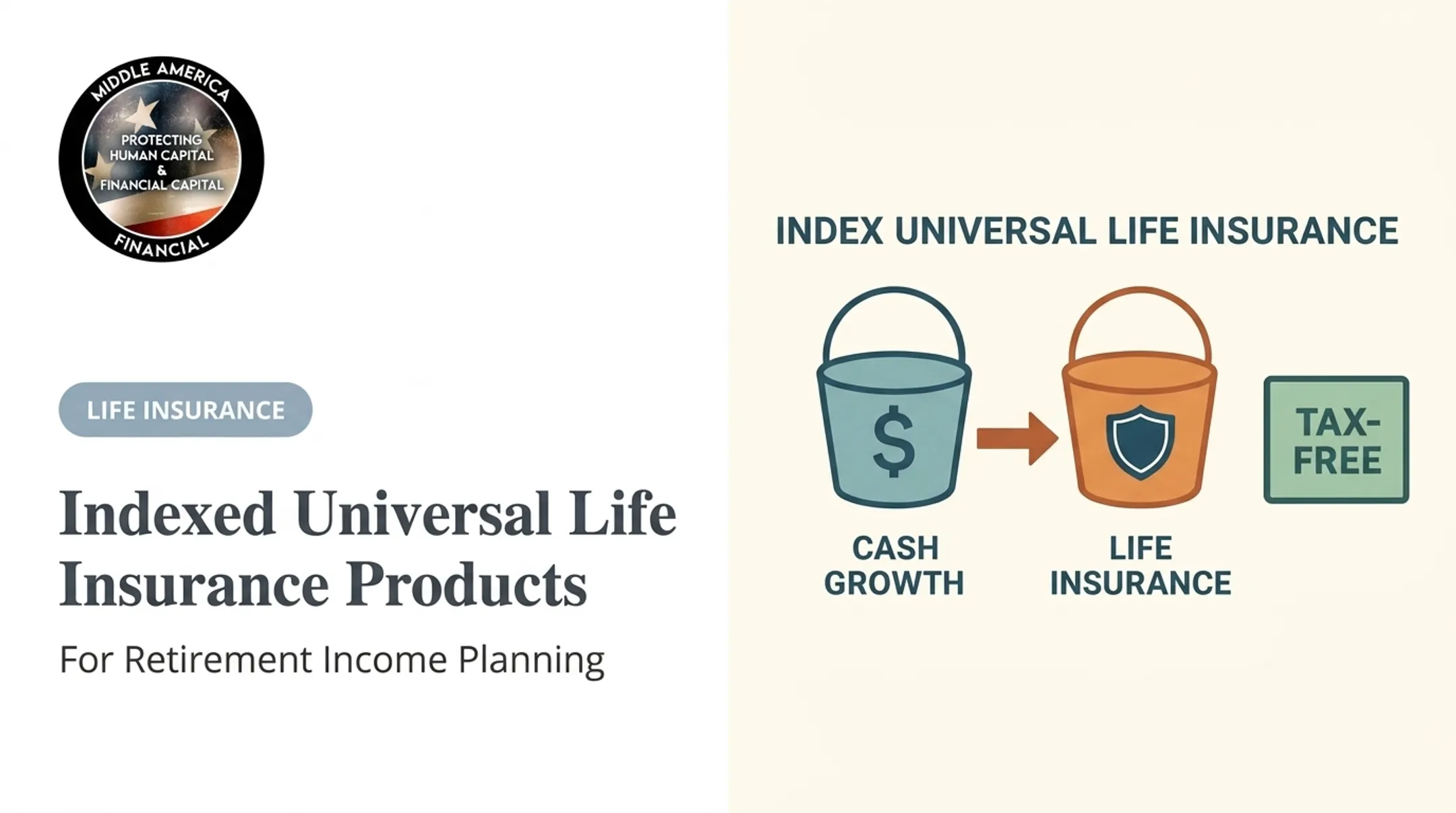
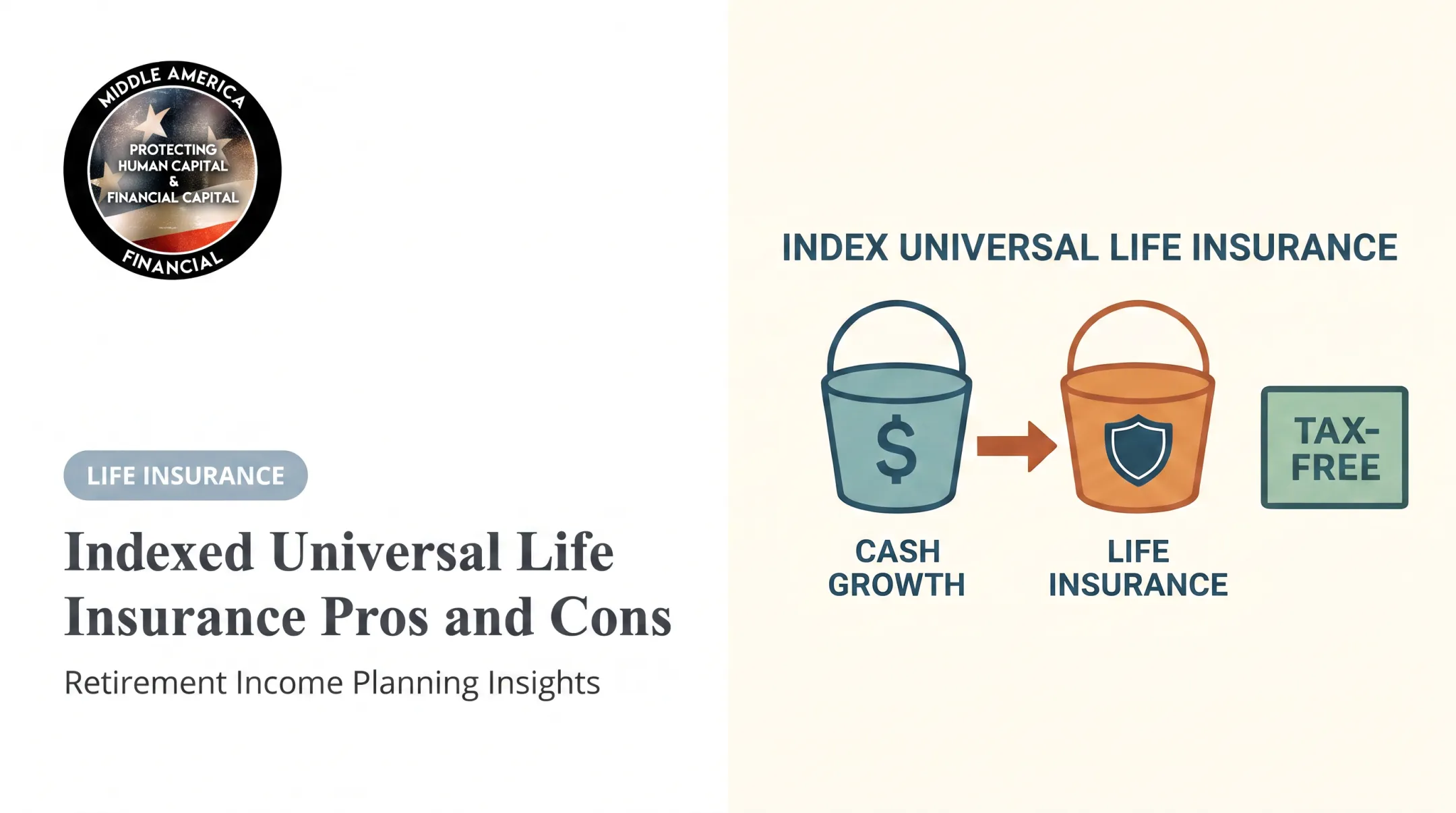
The appeal is obvious: a death benefit plus a cash value account linked to a market index like the S&P 500, without your money actually sitting in the market. But here's the catch. Many buyers don't fully grasp how caps, floors, and participation rates work together, and that gap leads to unrealistic expectations about growth.
This guide breaks down exactly how IUL functions, step by step, so you can decide whether it fits your goals.
Quick Summary
- IUL combines permanent life coverage with a cash value account tied to a market index
- Premiums fund insurance costs and cash value; growth uses caps, floors, and participation rates
- A 0% floor typically blocks market losses, but caps limit upside gains
- You can adjust premiums, borrow against cash value, or withdraw funds for retirement income
- Best for long-term savers who have already maxed out 401(k)s or IRAs
What Is Indexed Universal Life Insurance?
IUL is a type of permanent universal life insurance where cash value growth is linked to the performance of a stock or bond market index. It sits in a middle ground: more growth potential than fixed universal life or whole life, but less downside risk than variable universal life.
What IUL is not: a direct investment in the market. Your cash value isn't buying shares of the S&P 500. Instead, the insurer uses a crediting formula—often built with options strategies—to decide how much interest gets added to your account each year.
People choose IUL because it offers:
- Flexible premium payments (within limits)
- Tax-deferred cash value growth
- Downside protection during market drops
How that works still depends on the carrier. Many policies let you pick indexes such as the S&P 500, Russell 2000, or blended fixed accounts. Crediting methods also differ, including annual point-to-point and monthly averaging.
How Does IUL Insurance Work?
IUL follows a clear path: you buy the policy, premiums are split between costs and cash value, interest is credited off index performance (within policy limits), and you can later use the death benefit or living benefits. Here is how each stage works.
Purchasing the Policy
The process starts when you choose a coverage amount and complete underwriting, which reviews your health, age, and lifestyle factors. A licensed agent then walks you through an illustration showing how the policy might perform under different assumptions.
Important: illustrations show non-guaranteed, hypothetical projections, not promises. Many buyers skip past the fine print here and end up surprised later when actual performance differs from the illustration.
Premiums, Cash Value, and Crediting
Each premium payment gets split. Part covers the cost of insurance and administrative fees. The rest goes toward your cash value.
Cash value can be allocated between indexed accounts and fixed accounts. Insurers use options-based strategies internally to link your indexed portion's crediting to index performance. Your money is not directly invested in the market.
Three variables determine your actual credited interest:
- Cap: the maximum rate you can earn in a given period
- Participation rate: the percentage of index gains actually credited to you
- Floor: the minimum credited rate, often 0%
Carrier illustrations make the math concrete. With a 12% cap and a 15% index gain, you are credited 12%—the cap cuts off the rest.
In another case, an 8% index gain at 100% participation with no cap credits the full 8%. Drop participation to 60% and the credit falls to 4.8%, per National Life Group illustrations.

Consistent funding, index performance, and fees all determine how fast cash value builds.
Caps, Floors, and Policy Management
The floor, often 0%, prevents losses when the index has a bad year. The cap limits your upside during strong years. Together, they create a narrower band of outcomes than direct market investing.
Policyholders need to monitor their funding levels. If fees outpace cash value growth, the policy can lapse.
There's also a tax guardrail called the 7-pay test, which determines if a policy becomes a Modified Endowment Contract (MEC). Overfund the policy too quickly and it fails this test. According to IRS Revenue Ruling 2007-38, MEC status changes how loans and withdrawals are taxed, generally treating them as income first and potentially adding a 10% penalty.
This stage matters because underfunded or mismanaged policies can lapse, costing you both coverage and potentially triggering unexpected tax consequences.

Death Benefit and Living Benefits
IUL produces two main outputs:
- A death benefit paid to your beneficiaries, generally income tax-free
- Accessible cash value you can tap during your lifetime
Access method changes the tax picture:
- Loans generally are not taxed while the policy stays in force
- Withdrawals are typically tax-free up to premiums paid; earnings are taxed after that, and MEC rules can recharacterize both loans and withdrawals
A well-funded IUL can serve double duty: lifelong protection and a source of supplemental retirement income. This connects directly to strategies that business owners and pre-retirees explore when building tax-efficient wealth outside of traditional retirement accounts.

Where Is IUL Insurance Used?
IUL fits several planning scenarios:
- Lifelong income protection for dependents
- Supplemental retirement income
- College funding
- Key-person coverage for business owners
- Estate and legacy planning
It works best under specific conditions:
- A long time horizon (10+ years)
- Stable ability to keep paying premiums
- Tax-advantaged accounts like a 401(k) or IRA already maxed out
Cap rates, fees, and crediting methods vary significantly by carrier. An independent brokerage that represents multiple carriers, such as Middle America Financial, lets you compare terms across companies rather than relying on a single insurer's policy design.
IUL vs. Other Life Insurance Options
| Feature | Term Life | Whole Life | IUL | VUL |
|---|---|---|---|---|
| Cash value | None | Guaranteed, fixed (typically 1-3%) | Index-linked, capped | Directly invested, no cap |
| Coverage length | Temporary | Permanent | Permanent | Permanent |
| Risk level | N/A | Low | Moderate | High |
| Growth potential | None | Low, predictable | Moderate, capped | Highest, uncapped |
Term life is the simplest and cheapest option, but it offers no cash value and expires after a set period. Whole life provides guaranteed, fixed growth without market exposure.
IUL sits between those two and variable universal life. Credited interest tracks a market index, with a floor that protects against losses and a cap that limits upside. VUL sits at the far end: no cap on gains, but full market exposure means losses hit your cash value directly.

Cost, complexity, and your risk tolerance should all factor into this decision. Speaking with an independent agent who can compare products across carriers tends to produce a better fit than a single-carrier pitch.
Conclusion
IUL works through a structured cycle: you pay premiums, index-linked crediting applies caps and floors, and you keep flexible access to the cash value. Knowing how that mechanism works—not assuming market-like returns—sets realistic expectations from the start.
Before committing, review any illustration carefully and ask what's guaranteed versus projected. A knowledgeable independent agent at Middle America Financial can help you compare carriers and structure a policy that matches your goals.
Frequently Asked Questions
How much does an IUL cost per month?
Cost varies widely based on your age, health, coverage amount, and funding strategy. There's no reliable universal monthly figure, so getting a personalized quote is the only way to know your actual cost.
How much money do I need to open an IUL?
There's no fixed minimum. However, funding needs to align with your coverage amount and long-term goals, since overfunding too quickly can trigger MEC status and change how your policy is taxed.
How much can I borrow from my IUL?
Loan amounts depend entirely on your accumulated cash value. It typically takes several years of consistent funding before there's meaningful cash value to borrow against.
Is an IUL better than a 401(k)?
Not a replacement. IUL works best as a supplemental strategy once you've already maximized contributions to accounts like a 401(k) or IRA.
How do you make money with an IUL?
Cash value grows through index-linked interest crediting, subject to caps and floors, then you can access it later through tax-advantaged loans or withdrawals.
What is the average rate of return on an IUL?
Returns depend on the specific cap, participation rate, and actual index performance for your contract. There's no reliable industry-wide average, since illustrated projections differ from real historical crediting results.