Many people wrestle with the same questions before buying a policy. How does term coverage actually work? What will it cost? Is $250,000 enough, or should it be $500,000? And what happens when the term runs out?
This guide breaks down term life insurance in plain language: how policies work, what drives pricing, how term compares to whole life, and how to choose a policy that actually matches your family's needs in the United States.
Quick Summary
- Term life insurance pays a death benefit only if you die during the policy's active term, and it typically builds no cash value.
- Premiums depend on age, health, tobacco use, coverage amount, term length, and occupation, not a single flat rate.
- Match your term length and death benefit to real obligations: remaining mortgage years, your kids' ages, and income replacement needs.
- Check renewal, conversion, and exclusion terms before buying, since they vary by insurer and policy.
What Is Term Life Insurance?
Term life insurance is temporary coverage. You pay premiums for a set period, and if you die during that period, your beneficiaries receive a death benefit, as long as the policy stays in force and its terms are met.
The National Association of Insurance Commissioners describes term coverage as insurance issued for a set period, commonly 1, 5, 10, or 20 years, or to a specified age such as 65.
The Basics: Who's Involved and What's Covered
Every term policy shares the same core pieces:
- Policy owner — the person who buys and controls the policy (often the insured)
- Insured — whose life is covered
- Beneficiaries — who receives the death benefit
- Premium — what you pay, monthly or annually
- Death benefit — the payout amount
- Effective date and lapse terms — when coverage starts and what happens if you stop paying

Common Term Lengths
Insurers commonly offer 10-, 15-, 20-, and 30-year terms, though exact availability varies by carrier and state. Some simplified-issue products offer coverage in the $25,000 to $400,000 range without a full medical exam. Amounts, term options, and underwriting rules vary by carrier and state, so confirm current terms before you apply.
What Term Life Doesn't Cover
Term insurance is straightforward, but it's also limited:
- No cash value. Most term policies build none.
- No payout for outliving the term, unless you have a return-of-premium feature.
- No coverage after expiration unless you renew, convert, or replace the policy.
Those limits are why term works best for needs with a clear end date. Common uses include:
- Replacing a working parent's income
- Paying off a mortgage
- Covering childcare or college costs
- Protecting a business partnership
The death benefit isn't locked to one purpose. Beneficiaries can use it however they need.
How Term Life Insurance Works
Term life coverage follows a clear path: you apply and get underwritten, choose how the benefit and premium behave over the term, then keep conversion, renewal, and beneficiary details current so a claim can be paid without delay.
Application and Underwriting
When you apply, insurers ask about age, health history, medications, tobacco or nicotine use, occupation, hobbies, and family medical history. How deep that review goes depends on the product:
- Fully underwritten policies may require a medical exam, blood work, and records review.
- Simplified-issue policies skip the exam but rely on health questions; premiums are typically higher as a result.
- Guaranteed-issue policies skip both the exam and questions, guaranteeing approval, usually with a smaller death benefit.
Level, Renewable, and Decreasing Term
Level term keeps the death benefit and premium fixed for the entire term. This is how most policies sold today are structured.
Renewable term lets you extend coverage without new medical underwriting, but premiums climb as you age. Renewal is usually capped by contract, often around age 70.
Decreasing term shrinks the death benefit over time, often matched to a declining mortgage balance. It can cost less, but the shrinking benefit may not keep pace with a family's broader income-replacement needs.

Conversion and Renewal Are Different Features
- Conversion lets you move to a permanent policy under the contract's rules, often without new medical underwriting, but typically within a deadline (before the term ends or before a stated age).
- Renewal extends term coverage for another period, generally at a higher premium tied to your current age.
Check both deadlines carefully. Assuming either option remains open indefinitely is a common and costly mistake.
Beneficiaries and Claims
The policy owner names primary and contingent beneficiaries. When a claim is filed, the insurer reviews it against the policy's terms before paying. Keep beneficiary designations current, and make sure your beneficiaries know where to find the policy documents. Store the policy where your beneficiaries can access it quickly when they need to file a claim.
How Much Does Term Life Insurance Cost?
There's no single price tag for term life insurance. Your premium depends on your underwriting profile, death benefit, term length, policy type, state, carrier, riders, and rate class at the same time.
Here are sample monthly premiums for a $500,000, 20-year level term policy at the Preferred nonsmoker rate class, drawn from an October 2024 rate table:
| Age | Female (monthly) | Male (monthly) |
|---|---|---|
| 30 | $22.98 | $29.32 |
| 40 | $35.27 | $42.94 |
| 50 | $78.29 | $102.50 |
| 60 | $194.16 | $268.04 |
Figures reflect Policygenius's October 2024 average rate illustration for Preferred nonsmokers. Actual quotes vary by carrier, state, and health class.
Several factors drive where you land on that scale:
- Age and health shape your rate class and the risk the insurer prices in
- Tobacco or nicotine use often doubles or triples premiums versus nonsmoker rates
- Hazardous jobs or hobbies can limit eligibility or raise the cost
- Longer terms and higher coverage amounts increase the insurer's exposure, so premiums rise
How the policy is structured matters as much as the starting number.
Level Premium vs. Annually Renewable Term
A level-premium policy locks your rate for the entire term. Annually renewable term starts cheaper but rises every year as you age, and it can catch up to or pass level-term costs well before coverage ends. Compare total cost over your full timeline, not just year one.

Return-of-Premium Term: Read the Fine Print
Return-of-premium (ROP) term refunds your premiums, minus stated fees, if you outlive the term. It sounds appealing, but:
- ROP premiums typically run two to three times higher than standard term.
- Refunds depend on satisfying the contract's conditions in full.
- Cancelling early usually forfeits the refund entirely.
Some products, like Mutual of Omaha's Term Life Express or Americo's HMS Plus CBO, offer 100% of base premiums back at the end of a 30-year term. But riders, such as a Critical Illness benefit, may drop off on the ROP version. Read the actual contract, not just the marketing.
Before you lock in a quote, compare more than the first-year price:
- Guaranteed premium schedule and renewal rates
- Conversion period and available riders
- Exclusions and the insurer's financial strength
Because rates differ widely by carrier, an independent broker that shops multiple insurers—such as Middle America Financial's agent network—can help you line up side-by-side quotes for the same age, health class, and coverage amount.
Term Life vs. Whole Life Insurance
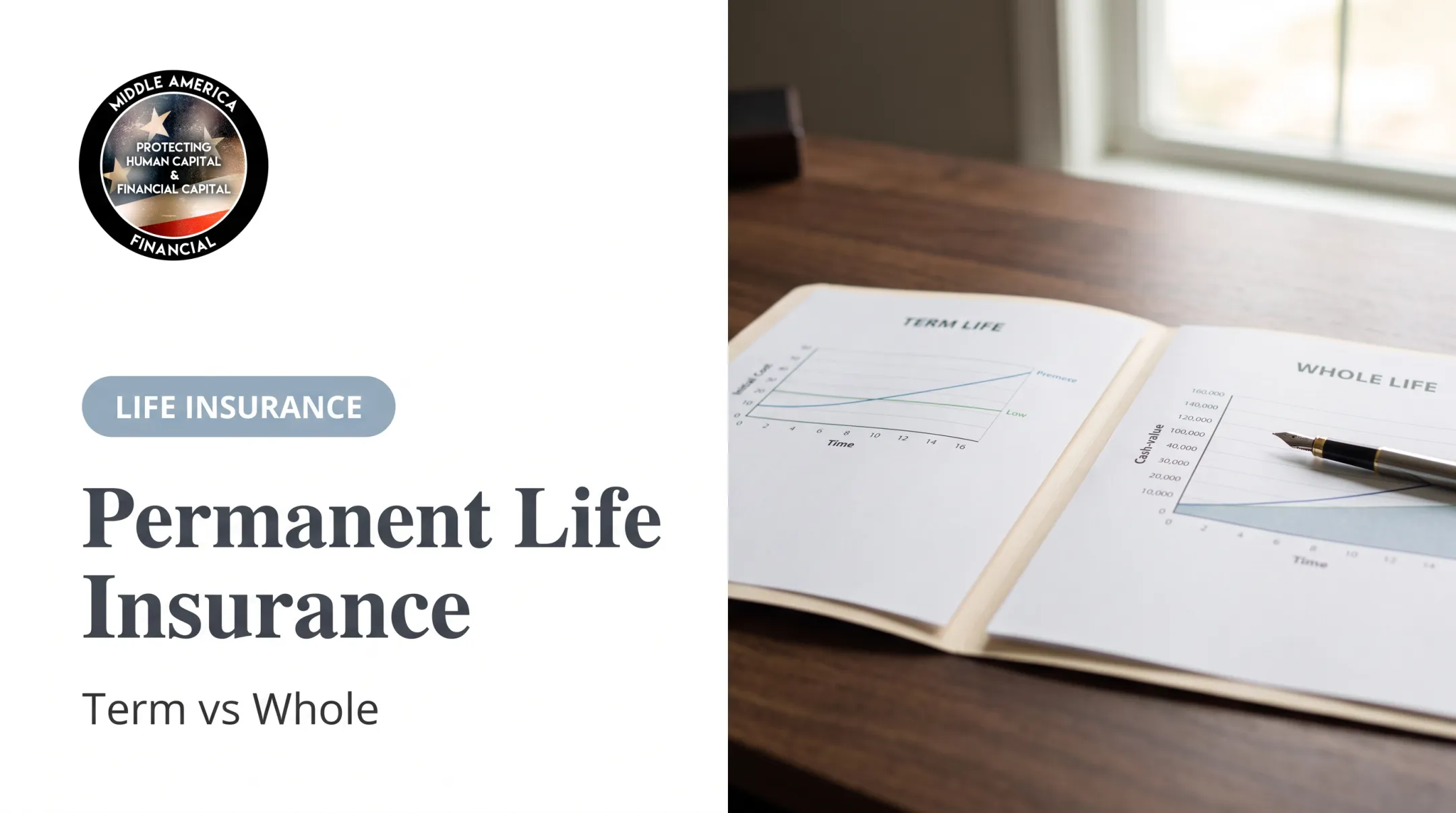
Term life protects you for a set period. Whole life is built to last your entire life if you keep premiums paid and the policy in force. The right choice depends on your budget, timeline, and whether cash-value features matter to you.
| Feature | Term Life | Whole Life |
|---|---|---|
| Duration | Fixed term (10–30 years) | Entire lifetime, if premiums are paid |
| Initial premium | Generally lower | Generally higher |
| Cash value | Typically none | Grows over time, often at a guaranteed 1%–3% rate |
| Death benefit | Paid only if death occurs during the term | Paid whenever death occurs, while in force |
| Complexity | Straightforward | More moving parts: cash value, loans, nonforfeiture options |
| At term's end | Coverage ends unless renewed or converted | Coverage continues for life |
Term may suit you if:
- You need substantial coverage during your working years
- Budget is a primary concern
- Your need is tied to a specific period, like a mortgage or child-rearing years
Whole life may suit you if:
- You want coverage that never expires
- Cash-value accumulation and borrowing options matter to you
- You can comfortably handle higher premiums and more policy complexity
One practical catch: if you outlive a standard term policy, there is typically no payout unless it includes a return-of-premium feature. Any guarantee still depends on the insurer’s claims-paying ability and the specific policy language—not the product type alone.
Choosing and Buying a Term Life Policy
Estimate What You Actually Need
Start with real numbers, not a rule of thumb:
- Remaining mortgage balance
- Final expenses
- Years of income your family would need replaced
- Childcare or education costs ahead
- Existing savings and any employer-provided coverage already in place
A generic "10x salary" formula doesn't account for a paid-off mortgage or a spouse's separate income. Build your number from actual obligations, not a shortcut.
Match the Term to the Obligation
Line up your term length with the years the need actually exists:
- Remaining mortgage term
- Years until kids are financially independent
- Planned retirement date
- Length of a business obligation or partnership agreement

Review the Fine Print
Before signing anything, check:
- Insurer identity and financial strength
- Premium schedule and whether it's guaranteed
- Contestability and suicide provisions in the contract
- Renewal terms, conversion rights, and deadlines
- Riders, beneficiary designations, grace period, and lapse consequences
Don't Assume Employer Coverage Is Enough
Group life insurance through work is convenient, but it's usually limited to a flat amount or one to two times your salary. It often doesn't move with you if you change jobs. Review it as a separate piece, not a substitute for individual coverage.
Once you know you need your own policy, the next step is comparing designs—not guessing from a single quote. That comparison across dozens of carriers takes time most people don't have.
Middle America Financial works through independent agents with access to more than 40 insurance carriers, so eligible U.S. consumers can compare policy options side by side for income, mortgage, and dependent protection. Product availability, underwriting, and pricing vary by state and carrier, so a licensed agent can confirm what is available where you live.
Before you apply:
- Gather your financial obligations and basic health information
- Request more than one quote or illustration
- Read the actual policy documents
- Speak with a licensed insurance professional
A few hours of comparison now can spare your family cost and confusion later.
Frequently Asked Questions
What is term insurance in life insurance?
Term life insurance is temporary coverage that pays a death benefit if the insured dies while the policy is active, provided premiums are current and policy conditions are met. It generally builds no cash value.
How much does $500,000 in term life insurance cost?
Cost varies by age, health, tobacco use, term length, state, and insurer. As one illustration, a 30-year-old nonsmoking woman paid roughly $22.98/month for $500,000 of 20-year coverage in a 2024 rate snapshot; a 30-year-old man paid about $29.32/month.
What happens when a 20-year term life insurance ends?
Coverage typically expires unless you renew or convert it under the contract's terms. Renewal is possible but usually costs more since it's based on your current age; converting to permanent coverage may still be available if the deadline hasn't passed.
What is the difference between whole life insurance and term insurance?
Term insurance covers a set period with generally lower initial premiums and no cash value. Whole life is designed for lifelong coverage and includes cash-value accumulation, but at a higher premium.
Is it a good idea to have term life insurance?
For many people, yes — especially if you need income replacement, mortgage protection, or coverage for dependents during a defined period. Whether it's the right fit depends on your specific needs and the policy's terms.
Do you get money back if you outlive term life insurance?
Standard term policies generally don't refund premiums. Some return-of-premium policies do refund base premiums if you meet the contract's conditions, but they typically cost two to three times more than standard term.