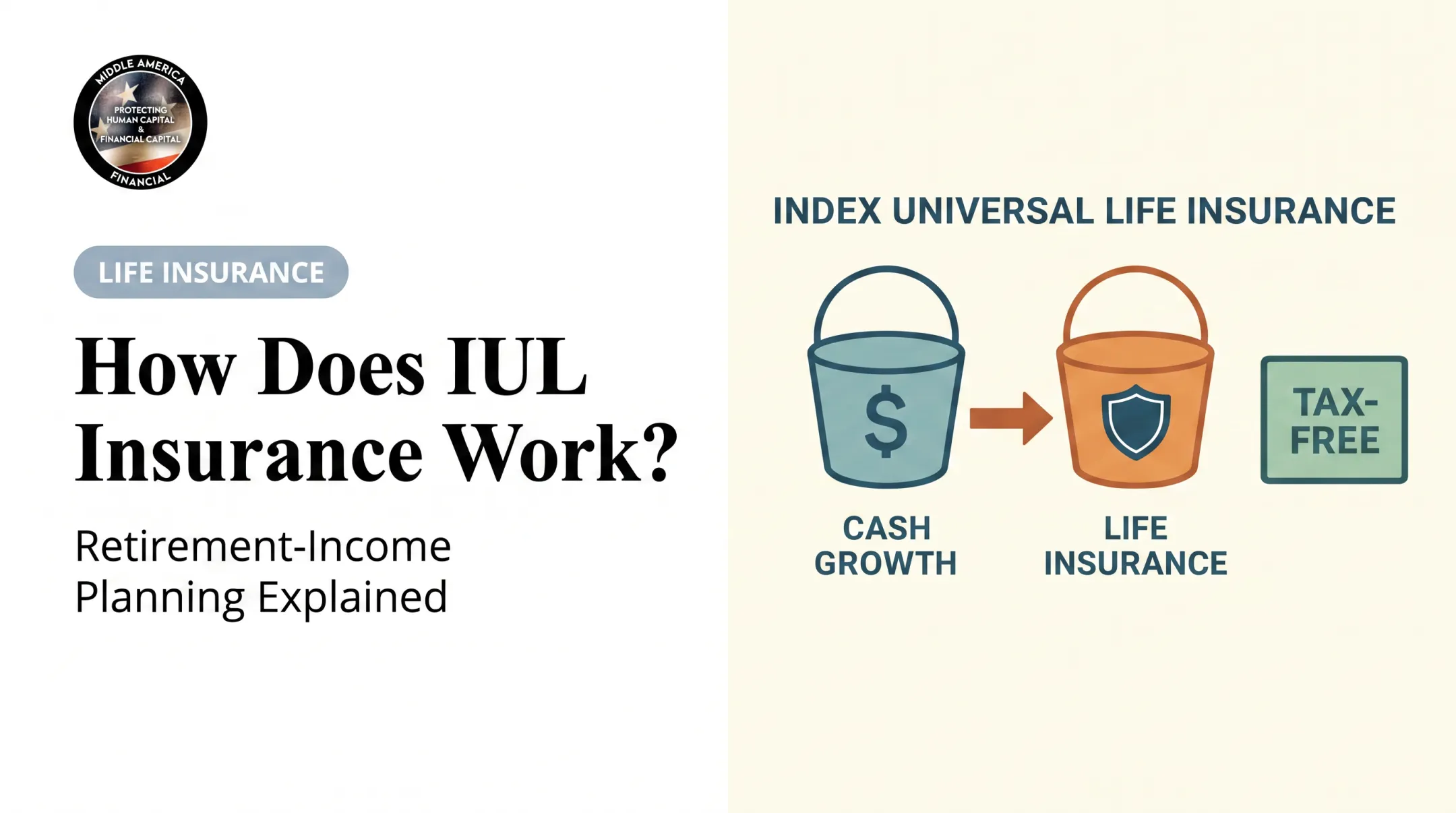
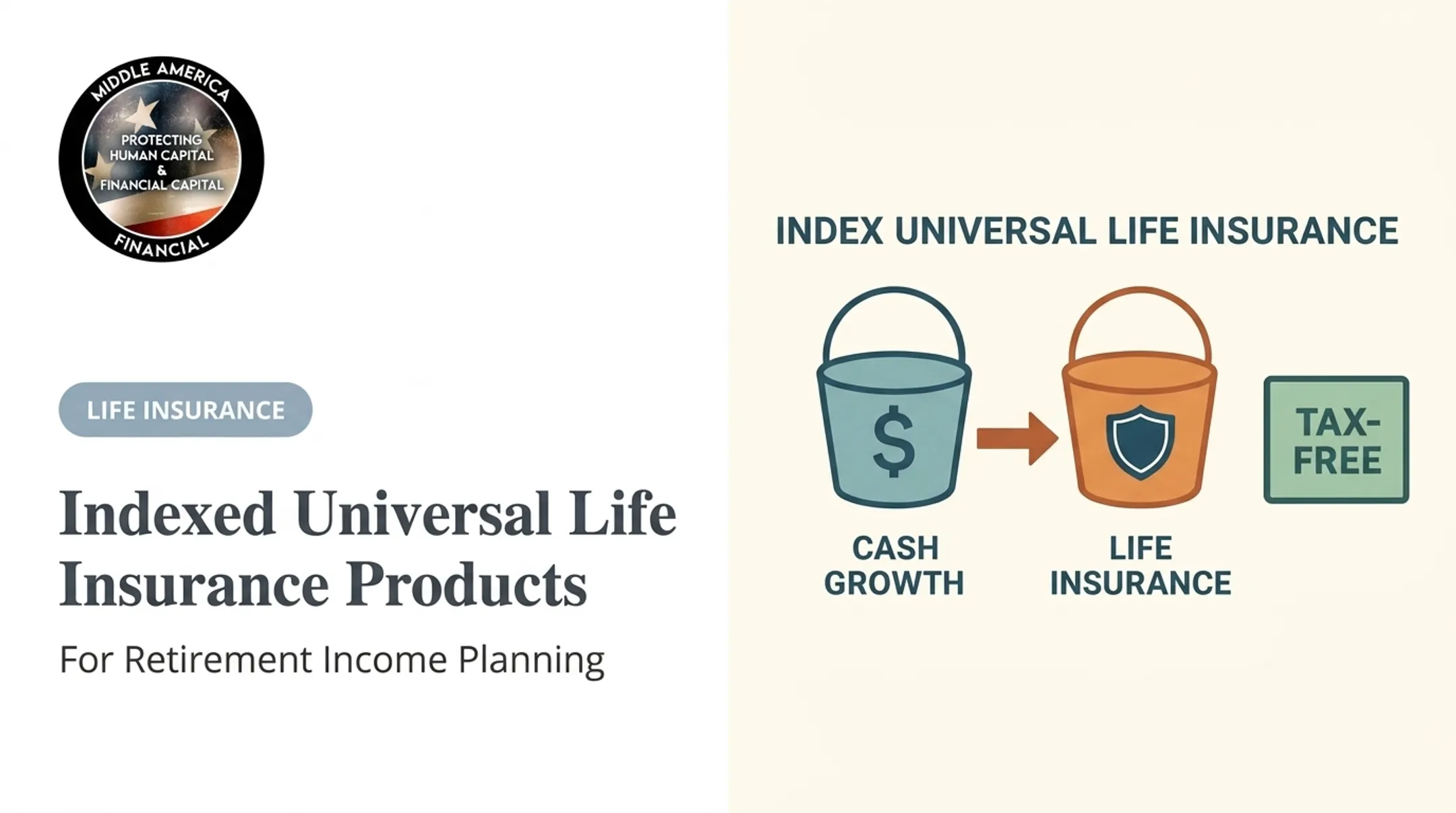
This distinction gets misunderstood constantly, even by people who already own a policy. This guide breaks down what a max-funded IUL actually is, how it works step-by-step, and when it makes sense for your situation.
Quick Summary
- A max-funded IUL pays the highest premium allowed without triggering Modified Endowment Contract (MEC) status
- Death benefit is set at the legal minimum so more premium builds cash value instead of insurance costs
- Cash value tracks a market index (cap and floor) and is accessible tax-free through policy loans
- Built for high earners who've maxed other retirement accounts and want supplemental tax-advantaged income
- Complements a 401(k) or Roth IRA—does not replace them
What Is a Max-Funded IUL?
A max-funded IUL is an Indexed Universal Life policy structured to pay the maximum premium the IRS allows while carrying the minimum death benefit permitted under Section 7702 of the tax code. That section requires a life insurance contract to qualify through either the cash-value-accumulation test or the guideline-premium and cash-value-corridor test. The corridor is measured against cash surrender value, not a flat percentage of premium. Why does this matter? A standard IUL's larger death benefit drives up cost-of-insurance charges every single month. Those charges eat directly into cash value growth. Max funding minimizes that drag by keeping the death benefit as low as the contract legally permits. What it is not:
- A separate insurance product category
- An investment account
- A guaranteed-return vehicle (growth depends on index performance, caps, and fees) Even so, max-funded IULs remain popular next to newer investment options. Buyers value the 0% floor, tax-free loan access, and freedom from the annual contribution caps that limit 401(k)s and IRAs. "Max funding" can apply to any IUL contract. How aggressive you run it—lowest allowed death benefit versus a little headroom—depends on your goals and risk tolerance.
How Does a Max-Funded IUL Work?
The process follows a defined sequence: premium calculation, cash value crediting, MEC testing, and eventual distribution.
Initiation: Setting the Premium and Death Benefit
The process starts by determining how much premium a client can pay consistently. From there, the agent uses carrier illustration software to calculate the minimum non-MEC death benefit for that premium amount, the client's age, and the planned payment period.
This isn't automated. It requires deliberate design, tied to the 7-Pay Test rules under Section 7702A. A sample Lincoln illustration on file with the NAIC shows a calculated 7-Pay Premium of $32,786.68 with a status labeled "Not a MEC," a concrete example of how carriers document this calculation at issue.
Common bottleneck: Agents often default to higher death benefits because it increases their commission. That choice directly reduces cash value efficiency for the client. This is exactly why the agent's design philosophy matters more than the carrier brand.
Core Operation: Premium Allocation and Indexed Crediting
Once premiums are paid, a portion covers cost of insurance and administrative charges. The remainder becomes cash value.
That cash value earns interest linked to an index like the S&P 500 through a crediting strategy — a cap rate, participation rate, or spread — without ever directly investing in the market. Terms vary widely by carrier. For example, Lincoln's WealthAccelerate IUL guide shows a 100% participation rate, a 10.50% cap, and a 0.25% floor, meaning a +30% index year still credits only 10.50%.
Compare that with other structures, such as 140% participation with a 6.00% cap or 50% uncapped participation:
| S&P 500 change | 100% participation / 10.50% cap | 140% participation / 6.00% cap | 50% uncapped participation |
|---|---|---|---|
| +4% | 4.00% | 5.60% | 2.00% |
| +10% | 10.50% | 6.00% | 5.00% |
| -10% | 0% | 0% | 0% |
Notice how the higher participation rate doesn't always win — it depends entirely on how the index performs that year. The lower the death benefit relative to premium, the smaller the cost-of-insurance drag, and the faster cash value compounds over time.

Regulation: Staying Within IRS Limits (7-Pay Test & MEC Rules)
The 7-Pay Test governs how much premium can go into a policy during the first seven contract years without triggering MEC status. Carriers monitor every premium payment against this test and can flag or return excess funds to keep the contract compliant.
Avoiding MEC classification isn't optional if tax-free access is the goal. Once a policy becomes a MEC:
- Loans and withdrawals become taxable, income-first
- A 10% penalty applies to taxable distributions before age 59½
- The policy still functions as life insurance, but loses its favored distribution treatment entirely
Output: Accessing Cash Value and Retirement Income
Policyholders access cash value through policy loans, not withdrawals, to avoid a taxable event. That loan-versus-withdrawal choice is what preserves tax-free access.
Here's how loans work: borrowed amounts can continue earning indexed credits on the full cash value balance (depending on whether it's a standard or participating loan), while loan interest accrues separately.
Midland National's contract materials, for example, describe standard loan rates typically around 6%, with some declared rates capped near 8%. Those figures vary by carrier and shouldn't be assumed universal.
This structure ties directly into retirement planning:
- Loan proceeds don't count as taxable income
- They don't affect Social Security taxation thresholds
- They're not subject to Required Minimum Distributions (RMDs)
One caveat: this favorable treatment only holds if the policy stays in force and does not lapse with an outstanding loan balance.

Max-Funded IUL vs. Standard IUL vs. 401(k)
| Feature | Max-Funded IUL | Standard IUL | 401(k) |
|---|---|---|---|
| Contribution limit | Governed by 7-Pay Test, not a fixed dollar cap | Same legal limits, less aggressive funding | $23,500 in 2025, plus $7,500 catch-up at 50+ |
| Tax treatment | Tax-free loans if non-MEC and in force | Same, but less cash value per premium dollar | Pre-tax growth, taxed on withdrawal |
| Market exposure | Indexed crediting with floor/cap, no direct market risk | Same crediting method | Direct market exposure through fund selection |
| RMDs | None | None | Generally starts at age 73 |
| Early withdrawal penalty | None on properly structured loans | None on properly structured loans | 10% penalty before 59½ on most distributions |
A max-funded IUL works best as a complement to qualified accounts, not a substitute. High earners who've already maxed their 401(k) and IRA contributions often add a max-funded IUL for this reason: it has no IRS-imposed dollar ceiling. The limit is set by the policy's own design, not a fixed government contribution schedule.
Who Should Consider a Max-Funded IUL
A max-funded IUL suits people who can fund it consistently and do not need the cash value early. Use the lists below as a quick fit check before you compare carriers.
Good fit:
- High-income earners who've maxed 401(k)/IRA contributions and want another tax-advantaged bucket
- Business owners looking for tax mitigation alongside protected, market-linked growth
- People who value downside protection (the 0% floor) over uncapped upside
Poor fit:
- People with inconsistent income that can't support sustained premium payments
- Anyone needing immediate liquidity in the first several years
- Investors who strongly prefer uncapped market returns over a capped, floored structure
Middle America Financial's independent agents work across a network of 40+ carriers, which matters here because crediting terms, loan provisions, and minimum death benefit calculations differ from one carrier to the next. Evaluating fit means comparing actual contract terms, not generic IUL averages, against a client's broader retirement and tax strategy.

Risks and Considerations Before Max Funding
Max funding can work, but only if you pressure-test the structural risks first.
Lapse risk from loans. If an outstanding loan balance exceeds cash value, the policy can lapse. That lapse can trigger a taxable event on the entire loan balance as ordinary income. The same exposure can apply if you surrender the policy or die with a loan still outstanding.
Commission-driven design. Agents earning higher compensation on larger death benefits have a built-in incentive to over-structure coverage. That works against a max-funded strategy, because more death benefit means more cost-of-insurance drag on cash value.
Non-guaranteed caps. Carrier cap rates aren't locked in for the life of the policy. A carrier can lower the cap after issue, which changes long-term projections significantly. Any illustration you review should clearly separate guaranteed columns from current, non-guaranteed assumptions. NAIC model regulations require that distinction, and you should insist on seeing it.
Conclusion
A max-funded IUL minimizes the death benefit and maximizes premium within IRS limits. The goal is tax-advantaged cash value growth, not a large payout at death.
Results still depend on structure. An independent agent should compare carrier terms, run in-force illustrations under weak market assumptions, and keep the death benefit from being inflated for commissions.
Middle America Financial helps clients review max-funded IUL designs across 40+ carriers so the policy is built for cash value first—and stress-tested before you fund it.
Frequently Asked Questions
What is a max-funded IUL?
It's an Indexed Universal Life policy structured with the minimum allowable death benefit and the maximum allowable premium, prioritizing cash value growth over a large death benefit.
Is a max-funded IUL a good idea?
It depends on your income stability, existing retirement savings, and whether you value tax-free liquidity and downside protection. It's not a fit for everyone.
How much money can I put in an IUL?
There's no fixed dollar cap. Contribution limits are governed by the IRS 7-Pay Test and vary by age, health, and the death benefit level you choose.
How much money can I borrow from my IUL?
You can typically borrow a high percentage of your accumulated cash value, but exact limits and loan interest rates depend on your carrier's terms.
Can you use an IUL for retirement?
Yes. An IUL can supplement retirement income through tax-free policy loans, but it works best alongside a 401(k) or IRA, not as a replacement.
Is a max-funded IUL better than a 401(k)?
They serve different purposes. An IUL offers no annual IRS contribution cap and no RMDs, while a 401(k) offers pre-tax contributions and employer matching. Most high earners use both.